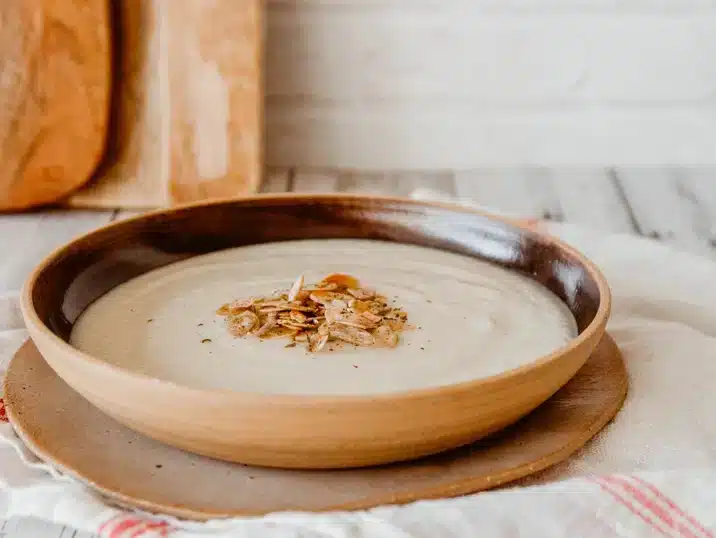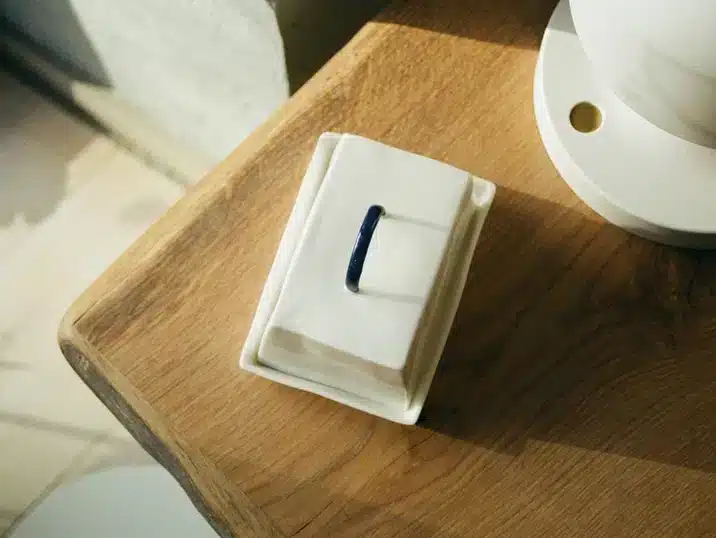

But what exactly is ceramics? What are the properties of ceramics and what materials do you need to get started? The answers to these questions and some creative examples of ceramics can be found below.
Ceramics is...
In short, ceramics are baked clays. This clay can be divided into three categories: earthenware, stoneware, and porcelain. The collective name for these three categories is ceramics.
The word ‘ceramics’ comes from the Greek ‘keramos’, meaning ‘drinking vessel’ or ‘earthenware vessel’.
The beauty of ceramics lies in its versatility. Anyone can make ceramics. Clay is easy to shape. This means that you can make almost anything out of it. You don’t necessarily need a special potter’s wheel; you can also work freehand.
Want to try your hand at clay?
Properties of ceramics
There are many different types of clay. These differ not only in colour, but also in plasticity, strength, water absorption and structure. This means that different types of clay are used for different purposes. Some types of clay are more suitable for novice ceramists than others.
- Plasticity
Plasticity refers to how malleable your clay is. The more plastic the clay, the more malleable it is. If your clay is less plastic, it will be harder to shape. Plastic clay is soft and workable, and it easily retains the shape you give it. - Strength
Strength is an important property of ceramics and indicates how much weight your clay can bear. Are you planning to make a large piece that can bear a lot of weight? If so, choose a stronger clay. This will ensure that your piece does not collapse. - Water absorption
Clay is always packaged in airtight containers. As soon as you remove it from the packaging, however, it starts to dry out. This is because it comes into contact with the air. To continue working with the clay, add water regularly. If you work slowly or are a beginner, it is best to choose clay that absorbs slowly. This will give you plenty of time to create your piece. However, if you choose a clay that absorbs quickly, there is a risk that you will add too much water, causing the clay to become too wet and no longer workable. - Texture
The texture of clay can vary; some types are rough, while others are smooth.
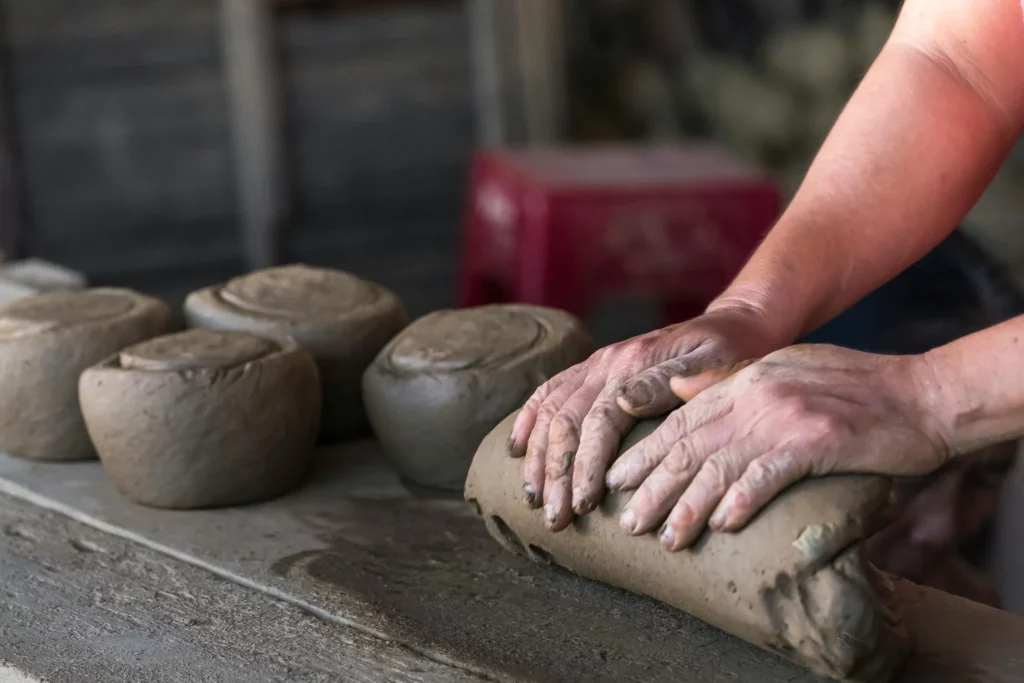
The type of clay you choose has a significant impact on the properties of the ceramics. There are many types of clay, so think carefully in advance about what you want to make. There is bound to be a clay that is perfect for your piece.
Before you start, ask yourself the following two questions: As well as considering the properties of the ceramics, you also need to answer these questions:
1)What is chamotte?
Chamotte is finely ground, fired clay mixed with fresh clay. This reduces the risk of shrinkage and cracking during firing. For throwing, it is best to choose clay with fine chamotte (0.2 mm) or none at all.
2) What is the ideal firing temperature?
The firing temperature is also very important. Earthenware is fired at between 900°C and 1150°C, while stoneware and porcelain are fired at higher temperature. Firing takes between eight and ten hours.
Tip: When buying clay, check the label to see what type it is, whether it contains chamotte, and what colour the ceramic will be after firing.
Ready to dive into the world of ceramics?
Which materials do you need for ceramics?
Now that you have examined the properties of ceramics, take a look at the materials you need to get started. In principle, you don’t need much, except for the clay itself, of course. A potter’s wheel is useful, but you can also create beautiful shapes by hand. However, if you want to learn how to throw pots, a potter’s wheel is essential.
To fire your clay, you will need a ceramic kiln. While it is possible to invest in your own kiln, bear in mind that this is an expensive undertaking. Fortunately, there are many people in worldwide who will fire your work in their kiln for a small fee.
As well as a potter’s wheel and a ceramic kiln, you will need some other materials to shape your clay. These include a bucket of water, an iron spatula, and a pair of scissors. It is also a good idea to visit a ceramics shop in your area and purchase the following items:
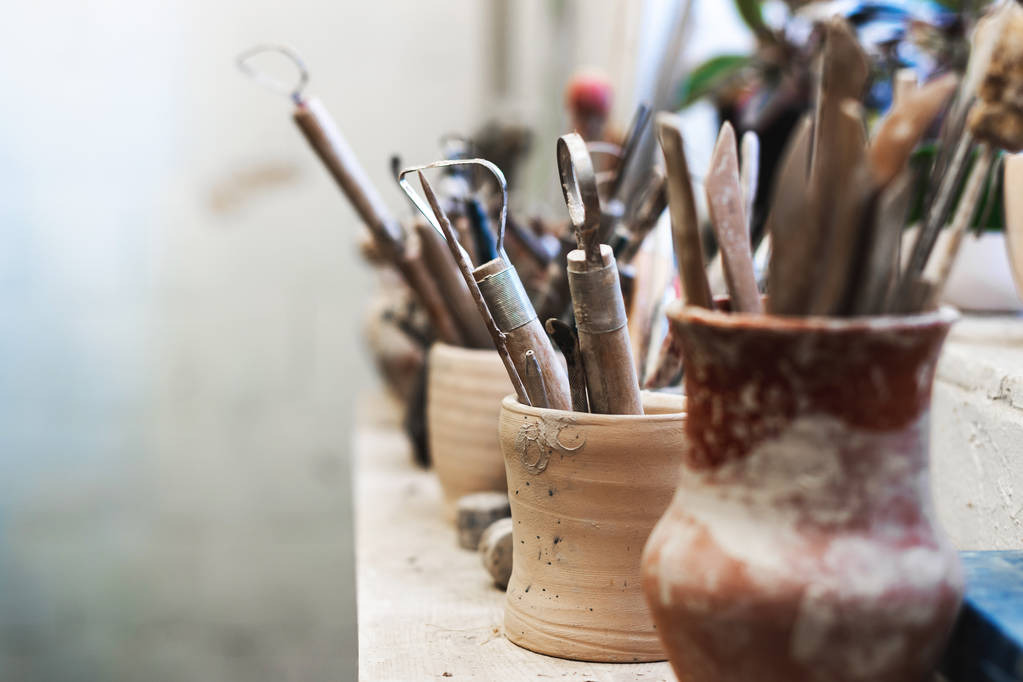
- Wire tool
This is what you need to cut a piece of clay. - Needle tool
EA cutting needle can be used for various purposes, such as testing how thin the bottom is or applying decorations. - Trimming tool
This tool, metal or wood, makes it easy to clean the base of your piece. - Mirette(s)
These fine instruments are suitable for numerous techniques. - Iron rib
A metal rib is used to create beautiful curves.
- Calipers
This is an easy tool to use to check whether your pieces are the same size without having to measure everything with a ruler. - Glaze
As a beginner, it is easiest to choose a ready-made glaze. Make sure that the glaze you choose is suitable for the firing temperature. Glazing is a skill in itself in the world of ceramics.- In our course ‘Using and applying glazes‘, you will learn everything there is to know about using glazes.
- In our course ‘Understanding and making your own glazes‘, you can experiment with powders and other glaze components to develop your own glazes.
- Glaze brush
A glaze brush is a useful tool for applying glaze.
Now that you know exactly what ceramics are and what materials you need, you can start making. Don’t be discouraged if you don’t immediately create the desired shape. Just keep trying and you’ll get there! The examples below are sure to inspire you!
Examples of ceramics
The possibilities with ceramics are endless.
Some examples:
And much more besides!
Feeling inspired to create your own beautiful shapes from clay?