As a ceramicist, your collection of clay scraps grows day by day, from failed pieces to small leftovers. Some of these cannot simply be used for your next piece because the clay has become too soft. Others are completely dried out and therefore too hard. Should you just throw them away? No way! You can easily bring these scraps back to life!
Step 1: Leave the clay to dry.
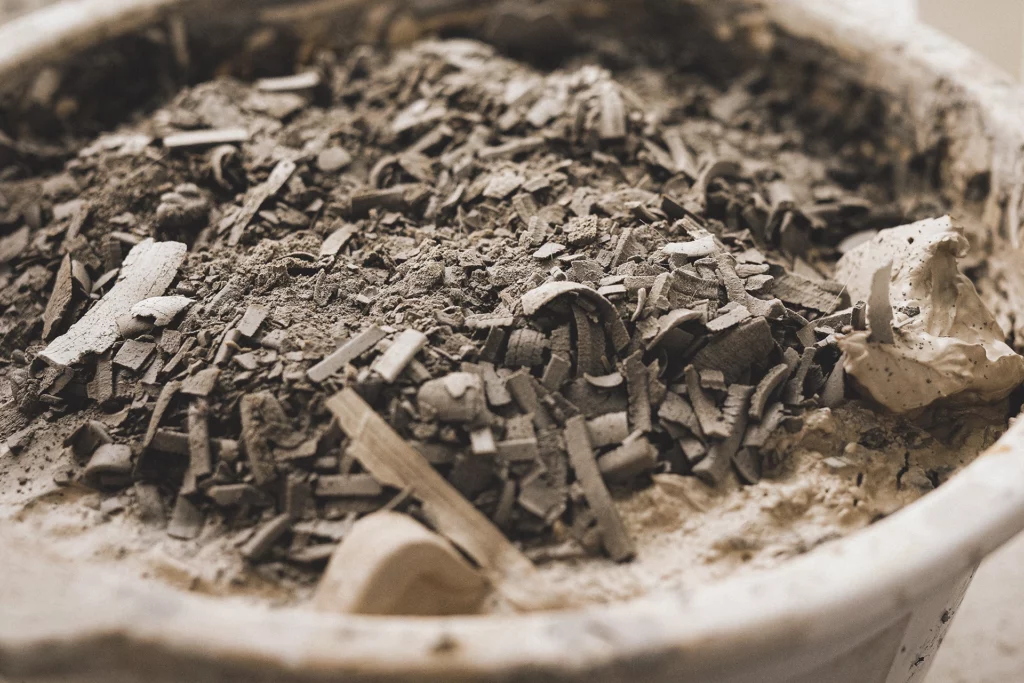
The best way to make use of your leftovers is to dissolve them completely in water. However, it is best to let them dry out completely first. This is because dry clay absorbs water much faster and more evenly than moist clay.
To speed up the process, break your clay scraps into small, thin pieces. Then it’s time to wait. Dry clay will take on the same temperature as its surroundings. Only when the clay is completely dry will it no longer feel cool to the touch.
Step 2: Soak the clay
Now that the clay is dry, you can move on to the next step. Place the clay scraps in a bucket and fill it with water. Make sure the water is a few centimetres above the clay.
You will see the clay dissolve quickly, forming a slurry. Leave the slurry to rest for a few hours. If a layer of water forms on the surface, carefully pour it off. It is best to do this outside to prevent clay particles from entering your water drainage system.
Step 3: Remove excess water
After resting for a few hours, the clay slurry is ready for the next stage. There are several methods you can use for this. One option is to pour the contents of the bucket into a double pillowcase, which you can then hang over another bucket. The excess water will gradually drip out of the clay into the bucket below. If you use this method, it is best to work with small amounts of clay per pillowcase at a time. This gives the best results.
Another option is to spread the clay on a plasterboard or some old towels. Please note that these towels may become severely discoloured afterwards. Only use towels that you don’t mind discolouring. Spread the clay thinly until you have a layer about five centimetres thick. The excess water will be absorbed by the plasterboard or towels. Please note that in warm environments, this can dry very quickly. Make sure your clay doesn’t dry out too much and check it regularly.
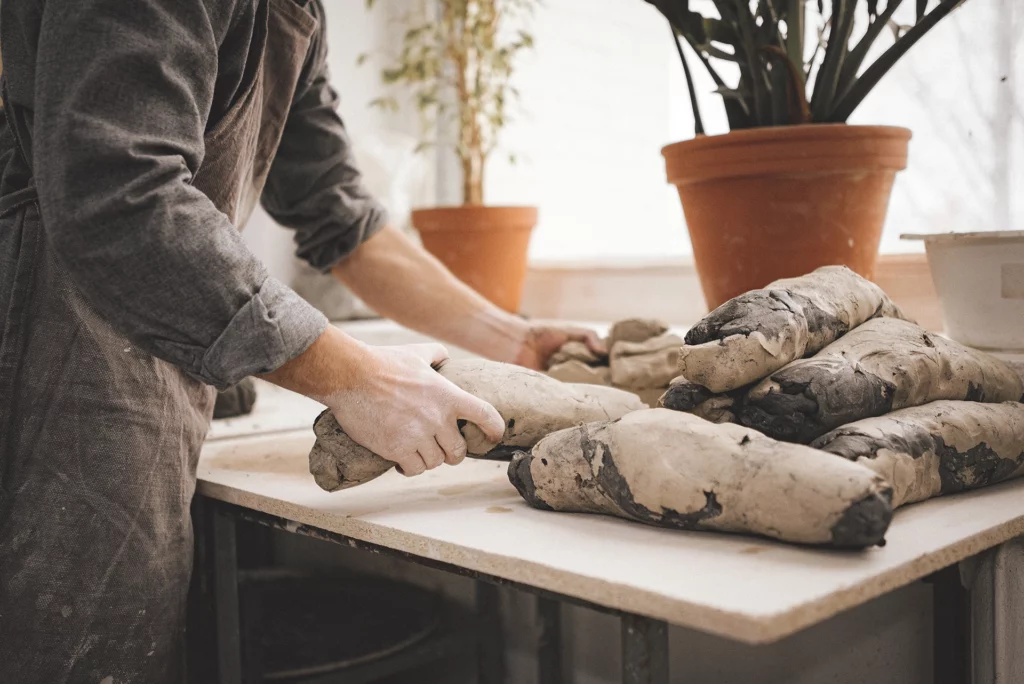
Your clay is ready when you can roll it into a ball without it sticking to your fingers. Please note that the clay still needs to be wedged before you can start working with it properly.
As a ceramicist, you will often find yourself with surplus clay that you want to reuse. Whether you use one of the above techniques or take a different approach entirely, it’s important to find a system that works well for you. This will ensure that you never waste any clay!